Book overview
This comprehensive publication covers all aspects of image formation in modern medical imaging modalities, from radiography, fluoroscopy, and computed tomography, to magnetic resonance imaging and ultrasound. It addresses the techniques and instrumentation used in the rapidly changing field of medical imaging. Now in its fourth edition, this text provides the reader with the tools necessary to be comfortable with the physical principles, equipment, and procedures used in diagnostic imaging, as well as appreciate the capabilities and limitations of the technologies.
Medical Imaging Physics covers all aspects of image formation in modern medical imaging modalities, from radiography, fluoroscopy, and computed tomography, to magnetic resonance imaging and ultrasound.
Medical Imaging Physics addresses the techniques and instrumentation used in the rapidly changing field of medical imaging.
Topics covered include:
* Digital x-ray imaging
* Doppler ultrasound
* Helical CT scanning
* Accumulation and analysis of nuclear data
* Experimental radiobiology
* Radiation protection and safety
* and contains over 200 figures
Medical Imaging Physics provides the reader with the tools necessary to be comfortable with the physical principles, equipment, and procedures used in diagnostic imaging, as well as appreciate the capabilities and limitations of the technologies.
Contents
1. Imaging in Medicine
2. Structure of Matter
3. Radioactive Decay
4. Interactions of Radiation
5. Production of X Rays
6. Radiation Quantity and Quality
7. Interaction of X and y Rays in the Body
8. Radiation Detectors for Quantitative Measurement
9. Accumulation and Analysis of Nuclear Data
10. Computers and Image Networking
11. Probability and Statistics
12. Instrumentation for Nuclear Imaging
13. Radiography
14. Fluoroscopy
15. Computed Tomography
16. Influences of Image Quality
17. Analytic Description of Image Quality
18. Visual Perception
19. Ultrasound Waves
20. Ultrasound Transducers
21. Ultrasound Instrumentation
22. Doppler Effect
23. Fundamentals of Magnetic Resonance
24. Magnetic Resonance Imaging and Spectroscopy
25. Magnetic Resonance Imaging: Instrumentation, Bioeffects, and Site Planning
26. Experimental Radiobiology
27. Human Radiobiology
28. Protection from External Sources of Radiation
29. Protection from Internal Sources of Radiation
30. Future Developments in Medical Imaging
Appendixes:
* Review of Mathematics.
* Fourier Transform.
* Multiples and Prefixes.
* Masses in Atomic Mass Units for Neutral Atoms of Stable Nuclides and a Few Unstable Nuclides
Mom, dad and two-year old child. The child is the patient. He has a runny nose, mild cough, congestion, stuffy, cranky and intermittent fever. You know. A cold. I really try not to be impatient with parents. I figure they are doing the best they can and it’s hard taking responsibility for another human being, especially a tiny one. But this too falls into the category of “really?” Do you really think this needs to be seen in an emergency room at 10 pm?
I guess I was even more irritated because about two minutes after meeting this family, I discover they already went to their own doctor a day and a half earlier (almost exactly 36 hours.) Their doctor put the child on an antibiotic already. So they were seen, examined, evaluated and treated. But it has been a whopping 36 hours and omigod! The baby is not fully well and omigod! What should we do!
So let me tell you, from this small encounter, a few things that are wrong with our American health care system.
1. First off, medically speaking, this child did not need antibiotics. No way. No how. Wrong, wrong, wrong. This child had a cold, plain and simple. Colds are viruses. Viruses are not bacteria, so an antibiotic, which is another way of saying anti-bacterial, is utterly ineffective. Another time we will talk about the actual negative implications of taking antibiotics when not necessary. The implications are huge.
2. Their doctor undoubtedly put the patient on antibiotics for one of two reasons. Probably he was hurried, and it is so, so, so much quicker to write a ’script than talk to the patient, especially if the entire family does not speak English. Or he took the path of least resistance. Many if not most patients do not believe a doctor who says that antibiotics (or x-rays, or CT, or MRI or blood tests etc) are not indicated. So we doctors learn it is less painful to not have our knowledge base continually trivialized by patients. (I have been asked at least a thousand times in my career: “How do you know it is a cold?” Or similar.) Not to mention keeping the customer happy, even if it is not good for the customer. We Americans have decided that customer satisfaction is an important variable in health care. And customers want tests and prescriptions.
3. The other reason the doctor may have prescribed antibiotics is that the doctor has already internalized such a risk-averse view of the American healthcare environment, that s/he cannot even think competently anymore in this regard. Many doctors now practice as if the 1% chance of something is the likeliest possibility. As in “there may be a 1% chance this is bacterial, so I should treat it as such.” That’s pretty much how it goes, and it is hard to tease out anymore what the doctor really thinks is going on clinically, from his perception and fears about malpractice and patient satisfaction. The doctor is pretty unaware that these factors have wormed their way into his clinical judgment. Because after all, most doctors know a cold when they see it. Except apparently when they are wearing their own white coat!
4. No ordinary, typical people who have to pay actual money to go see the doctor would normally wasted their own time and money like this. In the rest of their lives, normal people make “normal” decisions, taking into account the time and money factor. But these days the norm is to make abnormally ridiculous decisions, which is to run to the doctor. In fact, if people hesitate to run to the doctor, their friends and family are quick to criticize. “Have you gone to the doctor?” So the over-utilization of really expensive resources, which the ER is, is rampant and “normal.” Literally, only one generation ago people did not act like this. Up until the mid-1980’s people did not do this. But then the law changed, and people have internalized that as the new “normal.” More about that law in another post.
Last time I posted something about technology that helps (?) nurses so this time I posted something about technology that makes access to physicians easier for the general public. I think I like this, but I will have to think about it more. I can see that this could have a practical application for minor illnesses and would save time and money for most people. I can also see the doctor’s position–that there is no actual relationship with a patient and that they are reluctant to treat without face-to-face interaction.
However, the future is here with us now and we may all have to rethink our biases and our ideas of what health care is and is not.
By CLAIRE CAIN MILLER
Published: December 20, 2009
SAN FRANCISCO — Americans could soon be able to see a doctor without getting out of bed, in a modern-day version of the house call that takes place over the Web.
Enlarge This Image
Mark Graham for The New York Times
Dr. Christopher Crow conducting a simulated online exam in Plano, Tex.
Enlarge This Image
Mark Graham for The New York Times
A screen shot of that exam, which is not of an actual patient. Dr. Crow says the NowClinic system allows him to pick up on nonverbal cues, similar to an in-person visit.
OptumHealth, a division of UnitedHealth Group, the nation’s largest health insurer, plans to offer NowClinic, a service that connects patients and doctors using video chat, nationwide next year. It is introducing it state by state, starting with Texas, but not without resistance from state medical associations.
OptumHealth believes NowClinic will improve health care by ameliorating some of the stresses on the system today, like wasted time dealing with appointments and insurance claims, a shortage of primary care physicians and limited access to care for many patients.
But some doctors worry that the quality of care that patients receive will suffer if physicians neglect one of the most basic elements of health care: a physical exam.
“This is a pale imitation of a doctor visit,” said David Himmelstein, a primary care doctor and associate professor at Harvard Medical School. “It’s basically saying, ‘We’re going to give up any pretense of examining the patient and most of the nonverbal clues that doctors use.’ ”
Others, including Rashid Bashshur, director of telemedicine at the University of Michigan Health System, say online medicine is a less expensive way of providing routine care.
“The argument that you need the ‘laying on of hands’ to practice medicine is an old and tired argument that simply has no credibility,” he said. “There are two constants in medicine: change and resistance to change.”
Christopher Crow, a family physician in Plano, Tex., who used the system during its test period, said, “NowClinic gives you the ability to have that gut feel if something is wrong, in tone or facial expression or body language, that you have when you walk in the door with a patient.”
Many patients who do not have primary care physicians nearby use the emergency room for routine problems. Wait times for patients needing immediate attention have increased 40 percent, in part because of overcrowding, according to a study by Harvard Medical School and Cambridge Health Alliance.
In Texas, 180 counties do not have enough physicians, 70 percent of patients cannot obtain a same-day visit with their primary care doctor, and 79 percent of emergency room visits are for routine problems, according to OptumHealth.
“We are, through this technology, replenishing the pool of physicians and making them available to patients,” said Roy Schoenberg, chief executive of American Well, which created the system that OptumHealth is using.
For $45, anyone in Texas can use NowClinic, whether or not they are insured, by visiting NowClinic.com. Doctors hold 10-minute appointments and can file prescriptions, except for controlled substances. Eventually they will be able to view patients’ medical histories if they are available.
The introduction of NowClinic will be the first time that online care has been available nationwide, regardless of insurance coverage.
American Well’s service is also available to patients in Hawaii and Minnesota, through Blue Cross Blue Shield, and to some members of the military seeking mental health care, through TriWest Healthcare Alliance.
Some hospitals and technology companies provide similar services on a smaller scale, including Cisco, the networking equipment maker, which uses its videoconferencing technology to remotely connect employees with doctors. It is working with UnitedHealth Group to offer the service more broadly.
The service has encountered resistance in states where it is already available. Texas law requires that before doctors consult with patients or prescribe medicine online or over the phone, they form a relationship through means like a physical examination.
The Texas Medical Board, which regulates doctors in the state, is evaluating its telemedicine policies in light of new technologies. But Mari Robinson, executive director of the board, said that an online or telephone exam was inadequate if doctors and patients had not met in person and was “not allowed under our rules.”
After American Well’s service began in Hawaii last year, lawmakers passed legislation that allowed doctors and patients to establish a relationship online, though the Hawaii Medical Association opposed the bill.
“From our perspective, we still are a little bit concerned that a relationship can be established online with no prior relationship,” said April Troutman Donahue, the association’s executive director.
American Well and OptumHealth predict that health care professionals will adapt. “This is new technology, so you have a lot of code written that doesn’t take these medical technologies into account,” said Rob Webb, chief executive of OptumHealth Care Solutions.
Many patients seem ready to embrace the new technology. In a recent study, a Harvard research team at Beth Israel Deaconess Medical Center found that patients were comfortable with computers playing a central role in their health care and expected that the Web would substitute for face-to-face doctor visits for routine health problems.
In any language, Merry Christmas means the same. The reason for the season is the birth of a child in a manger. For Christians, this marks the day remembered as the birth of the Savior, Jesus, the Son of God. For us all, let us seek to have a new year filled with love, tempered with common sense and belief in values. Merry Christmas to all . . . obi jo and jomaxx
In those days a decree went out from Caesar Augustus that all the world should be enrolled. This was the first enrollment, when Quirinius was governor of Syria. And all went to be enrolled, each to his own city. And Joseph also went up from Galilee, from the city of Nazareth, to Judea, to the city of David, which is called Bethlehem, because he was of the house and lineage of David, to be enrolled with Mary, his betrothed, who was with child. And while they were there, he time came for her to be delivered. And she gave birth to her first-born son and wrapped him in swaddling cloths, and laid him in a manger, because there was no place for them in the inn.
Probably because I was kicked out from the bus and forced to walk in snow for half an hour yesterday, my cold got worse. My nose is runny and my voice has changed, and I have been blowing my nose all the time. So I went to a pharmacy to buy a cold medicine, and picked up my prescription drug as well (the prescription above is the unused one I got in the past). In UK, a prescription drug is free, but you pay NHS prescription charges for £7.20 (price from April 2009 to now). and usually a cheap generic medicine is given if you don’t choose others. A pharmacist often recommend to buy over-the-counter drug, if it is cheaper than prescription charge and if the ingredients and effectiveness are more or less the same with the prescription medicine.
I bought two homeopathy remedies from Boots, which supposedly effective for Swine flu, after I read the Epoch Times‘ (free paper founded by practitioners of the Falun Gong – I didn’t now it) article about it. First I had used Aconite (Aconitum napellus) , which can be helpful at the first sign of flu and cold symptoms. My condition had been the status quo for few days – I don’t know because of the effect of Aconite, or because I had been at home kept myself warm. Now my symptoms got worse and I started to take Arsen alb, which is “the most commonly indicated remedy for the H1N1 virus outbreak of early 2009,” as I read that it works for a blocked nose as well.
Homeopathy is not supported by modern scientific research, and it is said that there is little evidence the remedies work other than as a placebo. But homeopathy is £40 million industry in the UK, and Boots admits that they sell homeopathic remedies because “they sell, not because they work“. M believes only science, not homeopathy or alternative medicines – so do my parents who are both pharmacists. I myself don’t mind to try anything as long as it works and safe. I also understand people who find a hope in alternative medicines if there is no other cure. Let’s see if my homeopathic remedy works for me. I bought usual cold medicine as well, in case it doesn’t work at all.
The video below is the TV commercial of Beechams, the GlaxoSmithKline owned cold and flu remedy, that I happened to see on TV while I waswriting this entry. HSBC bank also used Sumo wrestler for their advertising last year. But HSBC was under fire as the campaign uses the image of a western man whose skin tone has been darkened and that make-up has been applied that appears to narrow his eyes, and it has upset Japanese living in UK, according to the Guardian article. Personally I don’t think it is a big deal – a portrayal of a foreigner is more or less based on a stereotype, not only Japanese. M complains that some Japanese TV programs make fun of ‘Gaijin’, foreigners in Japanese. At the end of the day, I think any country does the same, or otherwise it would be very boring if everything is goody-goody.
Dr. Stephanie Maj answers the most pressing question in her pediatric practice: What is the cause of ear infections and what can we do to heal them without drugs or surgery?
Chicago-Ask any parent about ear infections, and you will likely hear one horror story after another. Ear infection or Otitis Media, is the most common reason for visits to the pediatrician’s office. In fact, visits to the pediatrician’s office for ear infections have increased over 150% from 1975 to 1990. It is estimated that over 30 million visits are made every year in an attempt to deal with this problem.
In my practice, we have an effective, safe solution to the problems plaguing parents. What we find is most parents fail to understand what is happening with these infections.
Otitis Media is the general name for several conditions affecting the middle ear. The most common symptoms are earache, a feeling of pressure, and perhaps difficulty hearing due to increased amounts of fluid. Teething often produces similar symptoms, therefore, the child should be carefully observed before jumping to any conclusions.
Historically, the treatment for ear infections has been antibiotics. This method of treatment has come under severe attack over the past several years for many reasons. One of the reasons, the overuse and over prescription of these antibiotics, has led to what is termed “antibiotic resistant bacteria”. These bacteria have “evolved” and changed so that the antibiotics no longer affect them. Because of this phenomenon, stronger and stronger antibiotics are being used, which is leading to more and more resistance. (http://tinyurl.com/yep3y33)
Another reason use of antibiotics has come under fire is because study after study has demonstrated that they are not effective. In other words, they do not work! This is why so many children are on one antibiotic after another, stronger and stronger each time. Sure, many times the infection will go away, but it quickly returns with a vengeance, and so begins the antibiotic roller coaster.
The reasons they continually reoccur is two-fold: First, antibiotics kill off most bacteria in the body including the helpful “good” bacteria our bodies need. This depletes our children’s natural immune system, making them vulnerable to many more infections of varying types.
Secondly, antibiotics merely attempt to treat the symptoms of ear infections, they do not address the actual cause and therefore the infections return.
The real question then is what is the cause of ear infections? The reality is that ear infections themselves are merely a symptom of a greater problem. The vast majority of them are secondary to a cold or another infection, which may be due to a depressed immune system.
The other more physical reason children suffer from ear infections is because of the actual anatomy of the young ear.
In children, the Eustachian tube is nearly horizontal, gradually acquiring a near 45-degree angle. This often slows draining of these tubes and with stagnant fluid, infection may appear.
The obvious question from most parents now is: what can we do? The answer lies in a new level of thinking.
As a chiropractor, my primary objective is to address the root cause of health problems. Treating symptoms, as mentioned earlier, has been proven unsuccessful at best. When dealing with your children and ear infections, my goal is to correct the actual cause, and to allow the body to function at its optimal potential. (http://tinyurl.com/ybqlymw)
There is a direct link between the nerves in the neck (the superior cervical ganglion), the muscles of the Eustachian tubes (tensor veli palatini) and the middle ear.
Let me explain: The middle ear drains any fluid through the Eustachian tubes. These tubes open and close through the action of a muscle and that muscle is controlled by a nerve. This nerve originates in the neck. When this nerve is not functioning normally, the tensor veli palatini muscle may go into spasm, which constricts the Eustachian tube, restricting drainage and causing fluid buildup in the middle ear. This fluid, combined with a stressed immune system, may result in an ear infection.
Ultimately then, this “nerve interference” can cause your children to suffer as they do. My job as a chiropractor is to detect this nerve interference called subluxation, and correct it. A subluxation is a misalignment of a bone in the spine that pinches, stretches or twists a nerve resulting in interference.
By correcting this interference, the child’s body is given the potential to heal and be well. With proper chiropractic care, your child will be able to live a life free from nerve interference, and free from unnecessary medications and antibiotics.
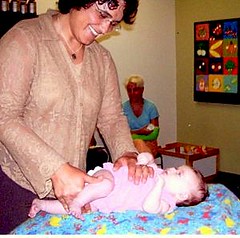
Chiropractic adjustments for children are very gentle and differ tremendously from the adult version. Imagine you are putting a contact in your eye or testing a tomato to see if it is ripe, that is the extent of the pressure used in these treatments. There is no twisting, popping or pulling involved.
Through advances in technology such as Surface EMG and Thermal Scans, a chiropractor can easily detect these subluxations and monitor their correction as well. This enables chiropractors to be accurate and objective, allowing you the best care possible.
A promising study published in the Journal of Clinical Chiropractic Pediatrics now indicates that there is a strong correlation between chiropractic adjustments and the resolution of ear infections. 332 children with chronic ear infections participated in the study. Each child, ranging in age from 27 days to 5 years, was given a series of chiropractic adjustments. The results show that close to 80% of the children in this study experienced NO ear infections within the six-month period following their initial visits. The six-month period included maintenance treatments every four to six weeks.
Correcting the cause through chiropractic has been shown to help over 80% of all children with ear infections.
Treating the symptoms of ear infections with antibiotics has proven to be ineffective. Give your children a fighting chance with chiropractic; it could change your lives!
ABOUT THE AUTHOR
Dr. Stephanie A. Maj has been helping children and adults experience life at their maximum potential through Chiropractic for over 14 years. She is the author of the book, “You Can Be Well” and lectures throughout Chicago on a variety of health issues, and may be contacted at 773.528.8485. Community Chiropractic is located at 1442 W. Belmont, 1E Chicago, IL 60657. Her website is www.communitychiropractic.net.
 Book overview
This comprehensive publication covers all aspects of image formation in modern medical imaging modalities, from radiography, fluoroscopy, and computed tomography, to magnetic resonance imaging and ultrasound. It addresses the techniques and instrumentation used in the rapidly changing field of medical imaging. Now in its fourth edition, this text provides the reader with the tools necessary to be comfortable with the physical principles, equipment, and procedures used in diagnostic imaging, as well as appreciate the capabilities and limitations of the technologies.
Book overview
This comprehensive publication covers all aspects of image formation in modern medical imaging modalities, from radiography, fluoroscopy, and computed tomography, to magnetic resonance imaging and ultrasound. It addresses the techniques and instrumentation used in the rapidly changing field of medical imaging. Now in its fourth edition, this text provides the reader with the tools necessary to be comfortable with the physical principles, equipment, and procedures used in diagnostic imaging, as well as appreciate the capabilities and limitations of the technologies.
![Reblog this post [with Zemanta]](http://img.zemanta.com/reblog_e.png?x-id=64e21c89-efe2-44f1-837a-c190649d4ae7)


![Reblog this post [with Zemanta]](http://img.zemanta.com/reblog_e.png?x-id=1cd8e7a8-3366-4714-94a0-73a2c50b3dae)